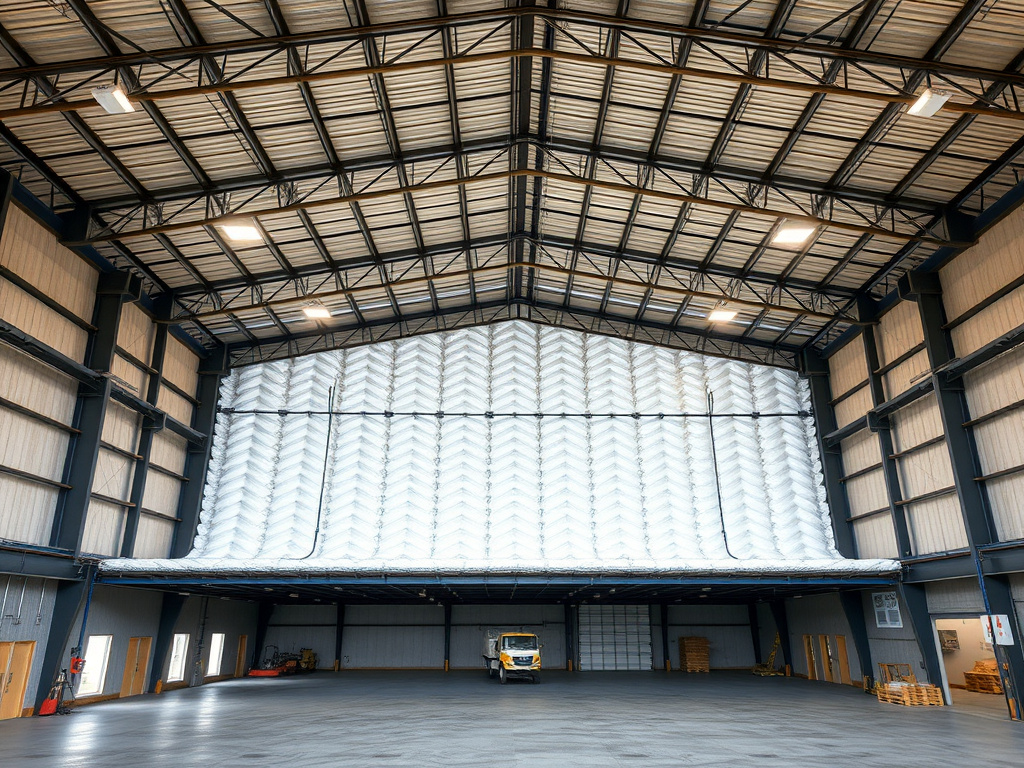
Commercial Buyer's Guide
Commercial Spray Foam Insulation: A Buyer's Guide for Building Owners
Warehouses, metal buildings, flat roofs, cold storage, and restaurant or flex space each put different demands on a spray foam system. This guide explains how commercial spray foam and SPF roofing actually work, how commercial bids are put together, and what to ask before you sign a proposal — then connects you with contractors who handle commercial-scale work.
What it is
Commercial spray foam covers a wider range of buildings than residential work
"Commercial spray foam" isn't one product or one job type — it's spray polyurethane foam (SPF) applied to non-residential buildings, which brings a much wider range of substrates, access conditions, and code requirements than a typical house. A warehouse roof deck, a pre-engineered metal building's wall panels, a flat commercial roof, a cold-storage facility's vapor-sensitive envelope, and a restaurant or flex-space buildout are all "commercial spray foam," but each one calls for a different foam type, thickness, and detailing approach.
For roofing specifically, commercial spray foam usually means an SPF roofing system: closed-cell foam sprayed directly onto an existing or new roof deck, then protected with an elastomeric coating. That combination is explained in more detail below, since understanding it is the fastest way to evaluate whether a commercial roofing bid actually describes a complete system or just the foam layer.
For wall and building-envelope applications, commercial jobs frequently use closed-cell spray foam rather than open-cell, because closed-cell's higher R-value per inch, added rigidity, and vapor-retarding properties matter more in metal buildings, cold storage, and other assemblies where moisture control and structural contribution are part of the specification, not just thermal performance.
Because the building types vary so much, this page focuses less on a single "how it's installed" walkthrough and more on how to evaluate a commercial spray foam proposal — the bidding process, the documentation a legitimate bid should include, and the questions that separate a complete commercial proposal from an incomplete one.
SPF roofing systems
How an SPF roofing system is actually built up
Spray foam roofing is not just "foam on a roof." It's a layered system, and each layer has a job. Building owners evaluating a bid should expect to see all of these components addressed, not just a thickness number for the foam.
| Foam layer | Closed-cell spray polyurethane foam (SPF) sprayed directly over an existing roof deck or substrate, built up to a specified thickness to provide both insulation value and a self-flashing, seamless membrane. |
|---|---|
| Protective coating | An elastomeric coating (commonly silicone, acrylic, or urethane-based) sprayed or rolled over the cured foam to shield it from UV exposure and foot traffic — foam alone isn't a finished roof surface. |
| Granules or surfacing | Some systems embed granules into the top coat for additional wear resistance and slip resistance on walkway paths. |
| Recoat cycle | The coating (not the foam itself) is the maintenance item — most manufacturers specify a recoat inspection and touch-up interval, commonly in the 5–10 year range, to keep the UV-protective layer intact over the life of the roof. |
| Why it fits low-slope and metal roofs | SPF roofing is sprayed on-site and self-adheres to irregular substrates, which makes it well suited to flat/low-slope commercial roofs and metal buildings with existing panel seams, penetrations, and HVAC curbs that are expensive to flash with sheet membrane. |
General description of how SPF roofing systems are typically built up — exact products, thickness, and recoat intervals vary by manufacturer and should be confirmed in your contractor's written proposal.
When it's the right choice
Who typically needs commercial-grade spray foam
Commercial spray foam tends to come up in a handful of recurring situations: an aging metal-building roof or wall system that's losing thermal performance and starting to show seam-related leaks; a cold-storage or refrigerated facility where vapor drive and condensation control matter as much as R-value; a flat-roof warehouse or distribution center where a seamless, self-flashing roofing system is easier to maintain than a seamed membrane; and restaurant, retail, or flex-space buildouts where a tenant improvement project needs the envelope brought up to current energy-code targets before occupancy.
It's also common on new commercial construction, where the building is being designed around a spray foam envelope from the start rather than retrofit onto an existing structure — a scenario closely related to what we cover on our new-construction spray foam page, since many of the scheduling and design-stage considerations overlap.
Restaurant and retail flex-space buildouts are a somewhat different case worth calling out on their own. These are usually tenant improvement projects on a fixed lease timeline, where the insulation scope is often smaller in square footage than a warehouse job but higher-pressure on schedule — a delayed opening date carries real revenue cost for the tenant. Contractors working this segment need to be comfortable coordinating around a landlord's base-building schedule and a tenant's build-out deadline at the same time, which is a different skill set than a standalone warehouse or metal-building project run on its own timeline.
Cost & bidding
Why commercial pricing runs per-project, not per-square-foot
Residential spray foam quotes cluster into a fairly predictable national range — roughly $1.50–$5.00 per square foot installed, depending on foam type — because most houses share similar framing, access, and scope. Commercial buildings don't share that consistency. A 40,000-square-foot warehouse roof, a walk-in freezer envelope, and a strip-mall tenant buildout have almost nothing in common structurally, which is exactly why legitimate commercial contractors quote per project after a site visit and plan review rather than publishing a flat per-square-foot rate.
The variables that move a commercial number the most: existing roof or wall condition (tear-off vs. spray-over), building height and access (lift or crane needs), specified foam thickness and coating system, code-required fire or thermal-barrier assemblies, and whether the job is bid plan-and-spec or design-assist.
Plan-and-spec bidding means an architect or engineer has already finalized the insulation and roofing specification, and contractors submit competitive bids against that fixed document — useful for comparing price apples-to-apples, but it locks in the spec before a contractor has had a chance to flag constructability issues.
Design-assist bidding brings a contractor in earlier, during design, to help shape thickness targets, system selection, and detailing before the spec is finalized. It tends to produce a system that's better matched to the actual building, at the cost of a less apples-to-apples bid comparison since each design-assist contractor may propose a somewhat different system.
Regional cost adjustors that apply to residential work — higher labor and access costs in the Northeast, coastal material-delivery upcharges, a metro-vs-rural labor gap — apply to commercial bids too, on top of the project-specific variables above. See how we organize contractors by region for the broader climate-zone framing behind those adjustors.
Climate & region
Climate and region considerations for commercial buildings
Climate zone drives commercial spray foam specifications the same way it drives residential ones, sometimes more strongly because commercial buildings often have larger, more exposed roof areas and tighter internal humidity requirements. In Southeast and Gulf Coast markets, vapor drive and hurricane-zone roof-deck bonding are regular parts of a commercial spec. In Northeast and Midwest markets, higher R-value targets and ice/snow-load considerations on low-slope roofs come up more often. In Southwest and hot-dry markets, UV exposure on the roof coating and cooling-load reduction tend to dominate the conversation, since these buildings see intense, sustained sun exposure on large flat roof areas.
Cold-storage and refrigerated facilities are a special case worth calling out regardless of region: the vapor-drive direction reverses (moisture is being driven inward toward the cold space rather than outward), which changes how a contractor details vapor control at penetrations and transitions. This is a detail worth raising directly with a commercial contractor rather than assuming standard building-envelope practice applies.
Before you hire
What to ask for in a commercial spray foam bid
A complete commercial proposal should give you more than a total price. Before you sign anything, ask the contractor to put these items in writing:
- ✓Code compliance documentation — the specific fire-rating, thermal-barrier, and ignition-barrier requirements that apply to your building type and how the proposed system meets them
- ✓Specified foam type and thickness in inches, not a vague "industry standard" reference, along with the resulting R-value
- ✓A thickness-verification method — how the contractor confirms and documents actual applied thickness across the job, not just the target spec
- ✓The elastomeric coating system and its manufacturer-recommended recoat cycle, so you can budget for the roof's real maintenance cost over time
- ✓Whether the bid is plan-and-spec or design-assist, and who is responsible for the final engineering sign-off
- ✓Substrate preparation and tear-off scope — is the crew spraying over the existing roof/wall, and if so, what condition does the substrate need to be in first
- ✓Active state contractor licensing where required, and a scope of work specific to your building rather than a generic template
- ✓A clear timeline that accounts for building occupancy, tenant coordination, or production-schedule disruption if the facility stays operational during the work
Red flags
Common mistakes and red flags on commercial bids
The most common mistake building owners make is comparing commercial bids purely on a bottom-line total without confirming the bids describe the same scope. A bid that specifies a thinner foam layer, skips the elastomeric top coat, or leaves substrate prep vague will almost always come in lower — and will almost always cost more over the roof's life once the gap shows up as a maintenance or performance problem.
Watch for a proposal that quotes a single flat price without describing the site-specific variables that produced it. On a genuine commercial project, that price should trace back to a site walk, a plan review, or both — a bid that skips that step is either guessing or working from a much thinner scope than your building actually needs.
Another recurring issue: no documented thickness-verification method. Spray foam thickness is easy to under-apply without it being visually obvious after the coating goes on, which is exactly why a credible commercial contractor should be able to describe how they confirm and document actual thickness — core samples, wet-film gauges during application, or another verifiable method — rather than asking you to take the spec on faith.
Finally, be cautious of any bid that treats the coating and recoat cycle as an afterthought. The coating is what protects the foam from UV degradation over the roof's service life; a bid that doesn't name the coating system or mention a maintenance interval is a bid that hasn't priced the roof's full lifecycle cost.
It's also worth asking who actually stands behind the finished system — the foam applicator, the coating manufacturer, or both — and under what conditions. A proposal that's vague about who is responsible if the coating fails early is telling you something about how carefully the rest of the scope was put together, even before the work begins.
FAQ
Commercial spray foam questions
Is commercial spray foam priced the same way as residential spray foam?
+
No. Residential jobs are commonly quoted in a fairly tight per-square-foot or per-board-foot range because the assemblies are similar house to house. Commercial projects vary too much in substrate, access, code requirements, and existing roof condition for a flat rate to mean much — most commercial contractors price per project after a site walk and plan review.
What's the difference between plan-and-spec and design-assist bidding?
+
Plan-and-spec means an architect or engineer has already finalized the insulation and roofing specification, and contractors bid against that fixed document. Design-assist means the contractor is brought in earlier to help shape the thickness, system, and detailing before the spec is finalized. Design-assist tends to produce a bid that's easier to compare against the finished building's actual needs, since the contractor had input on constructability.
How thick does commercial spray foam need to be?
+
It depends on the assembly, the climate zone, and the applicable energy code for that building type and jurisdiction — there's no single national commercial thickness standard. A legitimate commercial bid should state the specified thickness in inches (or the R-value it's engineered to hit) rather than leaving it as a vague line item.
Do commercial spray foam roofs need ongoing maintenance?
+
Yes. The foam itself is durable, but the protective coating on top of it is a wear item that benefits from periodic inspection and a recoat on the manufacturer's recommended cycle. Ask any commercial bidder what that maintenance cadence looks like before you sign, since it affects the roof's real lifetime cost.
Can spray foam be applied over an existing metal or membrane roof?
+
In many cases, yes — one of the reasons SPF roofing is popular commercially is that it can often be sprayed over a sound existing substrate instead of requiring a full tear-off, which is a cost and schedule question worth raising directly with a contractor who has inspected your specific roof.
Get matched with a commercial spray foam contractor
Tell us about your building — warehouse, metal building, cold storage, or tenant buildout — and we'll connect you with contractors who handle commercial-scale projects. Free, no obligation.