Buyer's guide
Home Energy Audits: What They Cost and What You Get
Before you spend money insulating a house, it helps to know exactly where that house is losing energy. A professional energy audit replaces guesswork with measurements — and gives a contractor the data to size your insulation job correctly the first time.
What it is
A diagnostic test for your house, not a sales pitch
A home energy audit — sometimes called a home energy assessment — is a structured, instrument-based inspection that measures how a house actually performs, rather than how it's assumed to perform based on its age or square footage. A qualified auditor combines a handful of specific tests, described in the table below, to build a picture of where a home is losing conditioned air, how much insulation is actually in place versus how much the climate zone calls for, and whether the duct system is delivering the air it's supposed to.
The output is a written report, usually with photos and thermal images, that ranks the problems it found by impact — a leaky attic hatch and an undersized wall cavity are not the same size problem, and a good audit tells you which to fix first.
It's worth being clear about what an audit is not. It's not a quote for insulation work, and it's not a substitute for a contractor's in-person assessment of your specific project. It's a diagnostic step that happens before or alongside that conversation, and its value is in turning “this house feels drafty” into a specific, measured list of where the air is actually moving.
This platform doesn't perform audits or installations itself — it connects homeowners with independently owned, licensed contractors who do this work. If you're not sure whether you need an audit or just an insulation upgrade, get matched with a contractor who can assess your specific situation.
What a professional audit includes
Four tests that turn guesswork into data
Not every audit includes every item below, and scope varies by auditor and by what a homeowner is trying to solve. These are the core components a genuinely instrument-based audit is typically built around.
| Blower-door test | A calibrated fan temporarily depressurizes the house so a technician can measure total air leakage (often expressed as air changes per hour) and pinpoint exactly where conditioned air is escaping — attic hatches, rim joists, recessed lighting, plumbing penetrations, and gaps around windows and doors. |
|---|---|
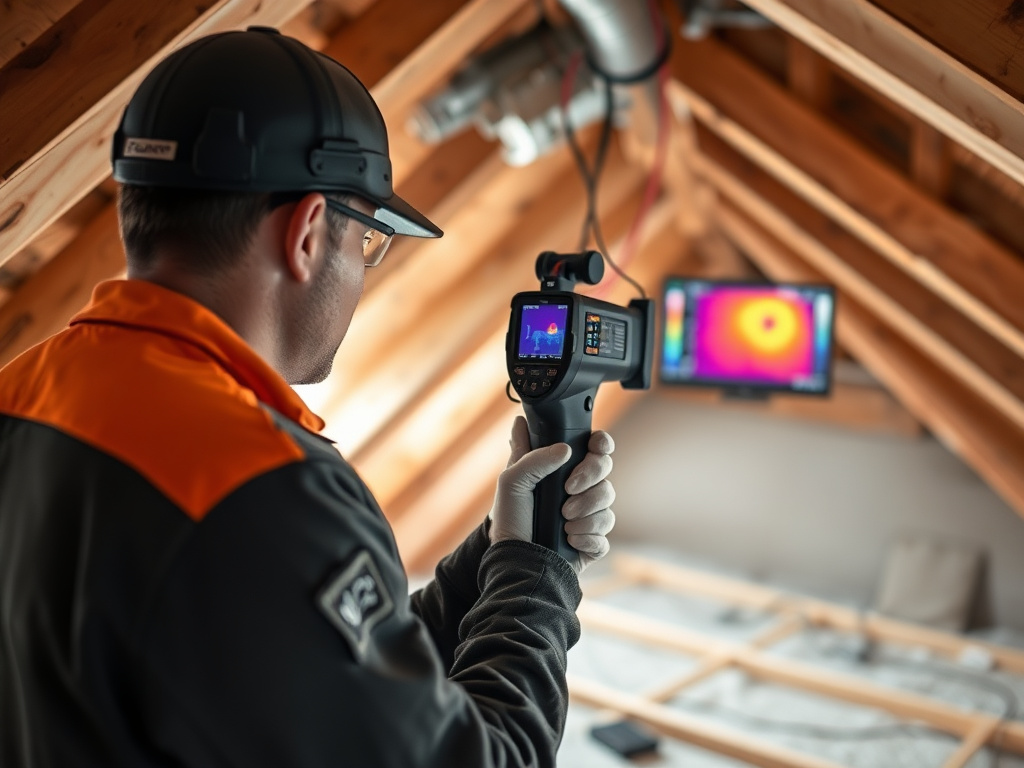
| Thermal imaging | An infrared camera scans walls, ceilings, and floors during the blower-door test to reveal temperature differences invisible to the eye — missing insulation, compressed batts, air leaks, and moisture intrusion all show up as distinct thermal patterns. |
| Duct leakage test | For homes with forced-air HVAC, a separate pressurization test measures how much conditioned air is leaking out of the duct system before it ever reaches a room — a major, frequently overlooked source of wasted heating and cooling. |
| Insulation depth check | A physical measurement of existing insulation depth and type in the attic and accessible wall cavities, compared against the R-value target for the home's climate zone, rather than a guess based on the home's age or a quick visual glance. |
| Combustion safety check | On homes with gas appliances, many auditors also test for backdrafting and combustion safety once the house is sealed up tighter, since air-sealing work can change how a furnace or water heater vents. |
General description of common audit components — ask a specific auditor which of these are included in their standard package versus offered as an add-on.
Why it matters for your insulation quote
Sizing the job to your actual heat loss, not a walk-through guess
Without audit data, a contractor quoting an insulation job is largely working from a visual walk-through: how old the house looks, how much insulation is visible in an accessible attic hatch, and general experience with similar homes in the area. That approach isn't dishonest, but it's a generalization — it can miss a severely under-insulated wall section, a duct system leaking a meaningful share of conditioned air into an unconditioned attic, or a bypass around a chimney chase that's quietly undoing the benefit of insulation elsewhere in the house.
An audit replaces that generalization with numbers: a blower-door result that quantifies total air leakage, a thermal scan that shows exactly which cavities are underperforming, and a duct test that puts a figure on how much of your heating and cooling bill is currently being spent on air that never reaches a living space. A contractor working from that report can size foam thickness, prioritize air-sealing ahead of or alongside insulation, and flag duct sealing as a separate line item — all before a single board foot of foam goes in. That's a meaningfully more accurate starting point for a quote than a walk-through alone, and it tends to prevent the common failure mode of insulating over air leaks that keep undermining the new insulation's performance.
What it costs
National cost range for a professional audit
Nationally, a professional home energy audit that includes a blower-door test and thermal imaging typically falls in the low-to-mid hundreds of dollars. More comprehensive audits — larger homes, added duct leakage testing, a detailed written report with modeled savings estimates — tend to run toward the higher end of that range or above it. These figures are directional and national, not a quote from this platform; your actual price depends on your home's size, your region, and how comprehensive an audit you're asking for.
A meaningful number of utilities subsidize or fully cover a basic energy audit for their customers as part of broader efficiency programs, so it's worth checking with your own utility before assuming you'll pay full price out of pocket. Regionally, expect the higher end of the national range in areas with a higher cost of living and denser urban labor markets, and the lower end in rural markets with more competition among independent auditors — though a trip charge can sometimes apply in lower-density areas. For a broader look at how region and climate zone affect insulation project costs generally, see find contractors by region.
Rebates and tax credits, honestly
The 25C federal credit expired — state and utility programs still vary widely
Here's a fact that applies nationally and is safe to state plainly: the federal Energy Efficient Home Improvement Credit (Section 25C), which previously let homeowners recover a share of qualifying insulation and audit costs on their federal taxes, expired for installations completed after December 31, 2025. If you're reading content anywhere — including older articles still circulating — that promises an ongoing federal tax credit for insulation or energy-audit work performed in 2026, that information is out of date. The related 25D residential clean energy credit followed a separate phase-down schedule of its own; neither should be assumed to apply to a 2026 insulation project without independently confirming current guidance.
State and utility rebate programs are a different story, and this is deliberately where we stop making specific claims: rebate and incentive programs vary enormously by state, and even by individual utility within a state, and they change from year to year as funding is renewed, expanded, or allowed to lapse. Rather than name programs here that we can't verify are still active in your specific location — which would risk sending you toward outdated or geographically irrelevant information — the honest answer is to check your own utility's website or your state energy office directly, and to ask your matched contractor what they've seen currently active for jobs in your area. Contractors who work regularly in a given region tend to have current, first-hand knowledge of what's actually paying out right now, which is more reliable than any general list a national platform could publish.
How an audit runs
What to expect during a typical audit visit
Walkthrough & intake
The auditor reviews the home's age, systems, and any specific comfort complaints — a cold room, high bills, ice damming — before testing begins.
Blower-door test
A calibrated fan depressurizes the house while the technician maps air leaks room by room, often with a smoke pencil or handheld thermal camera.
Thermal imaging & duct test
Infrared scans of walls, ceilings, and floors run alongside a duct leakage test if the home has forced-air HVAC.
Report & recommendations
You receive a written report ranking the findings by impact, which becomes the basis for a contractor's insulation and air-sealing quote.
Climate & region considerations
What an audit tends to find changes by climate zone
The problems an audit surfaces skew differently by region. In Northeast and Cold climates, blower-door tests frequently turn up significant heat loss through attic bypasses and ice-dam-prone eaves, and duct tests matter most when ductwork runs through an unconditioned attic or crawlspace. In Southeast and humid climates, thermal imaging is often used as much to spot moisture intrusion and vapor-drive issues as pure heat loss, since a home can be reasonably well insulated and still lose efficiency to humidity infiltrating through leaky assemblies. In Southwest and hot-dry climates, the audit's focus tends to shift toward cooling load and attic radiant heat gain over vapor concerns. Midwest homes typically show up with a mix of both cold- and hot-climate findings given the region's full seasonal swing, and Pacific and marine-climate audits often lean on moisture management findings more than extreme-temperature ones. See find contractors by region for the fuller picture of how climate zone shapes an insulation strategy generally.
Before you hire
Questions to ask an auditor before booking
- ✓Does the audit include a blower-door test and thermal imaging, or just a visual walk-through?
- ✓Is duct leakage testing included, and does it apply to my home's HVAC system?
- ✓Will I receive a written report with photos, or just verbal recommendations?
- ✓Does the audit fee get credited toward the job if I hire your company for the resulting insulation work?
- ✓Are you an independent energy assessor, or affiliated with a specific insulation contractor?
- ✓Do you carry any recognized building-science or auditor training or certification?
Common mistakes and red flags
- ✓A 'free audit' that turns out to be a same-visit sales pitch with no blower-door test or thermal imaging performed at all.
- ✓Skipping the audit entirely and accepting an insulation quote based purely on a quick visual estimate of an older home.
- ✓Assuming a 2026 project still qualifies for the federal 25C tax credit, which expired for installations after December 31, 2025.
- ✓Not asking whether duct leakage is included, then discovering after the insulation work that a leaky duct system was quietly wasting a large share of the savings.
- ✓Trusting a specific rebate-program statement from a generic national source instead of confirming directly with your own utility or state energy office.
- ✓Hiring based on the lowest audit price alone, without checking whether the cheaper option actually includes instrument-based testing.
Frequently asked questions
Energy audit questions, answered
Do I need an energy audit before getting a spray foam quote?
+
It's not required, but it's the difference between a contractor sizing your job to a guess and sizing it to your home's actual heat loss. If you're not sure what your project needs, select 'not sure / need an audit' when you submit a project and a matched contractor can start with an assessment instead of assuming a scope upfront.
How much does a home energy audit cost?
+
Nationally, a professional audit with a blower-door test and thermal imaging typically runs in the low-to-mid hundreds of dollars, with more comprehensive audits — larger homes, added duct leakage testing, a written report with modeled savings — running higher. Some utilities subsidize or fully cover an audit for their customers, so it's worth checking your own utility before assuming you'll pay full price.
Is there still a federal tax credit for insulation in 2026?
+
No. The federal Energy Efficient Home Improvement Credit (25C) expired for installations completed after December 31, 2025. Any current source telling you to install insulation in 2026 to recover money through that federal credit is out of date. State and utility rebate programs are a separate matter and vary by location — ask your matched contractor what's currently active in your area.
Will an audit tell me exactly how much insulation will save me?
+
A good audit gives you a data-backed estimate — based on your home's measured air leakage, duct losses, and insulation gaps — rather than a marketing number. Actual savings still depend on your climate, your energy rates, and how the recommended work is executed, which is why the report is a starting point for a contractor's quote, not a guarantee.
Can the same contractor perform the audit and the insulation work?
+
Often yes, though some auditors are independent energy-assessment specialists who don't install anything themselves and hand off a report for you to take to an insulation contractor. Either way, it's worth asking upfront whether the audit fee is credited toward the job if you hire the same company for the installation.
Related reading
Go deeper on insulation strategy
Attic Insulation
Where audit findings most often translate directly into an insulation scope, and what national cost ranges look like for the attic itself.
Spray Foam Cost by Region: A 2026 Climate-Zone Guide
The full national cost breakdown by foam type, project type, and climate region.
Full FAQ
All 24 questions on how matching works, cost, and the technical side of spray foam.
Not sure if you need an audit or just an insulation quote?
Tell us about your project — including 'not sure / need an audit' if that's where you're at — and we'll connect you with a licensed contractor who can assess it. Free, no obligation.